Dreadmoor Casts Off Into Early Access, and the Fish Fight Back
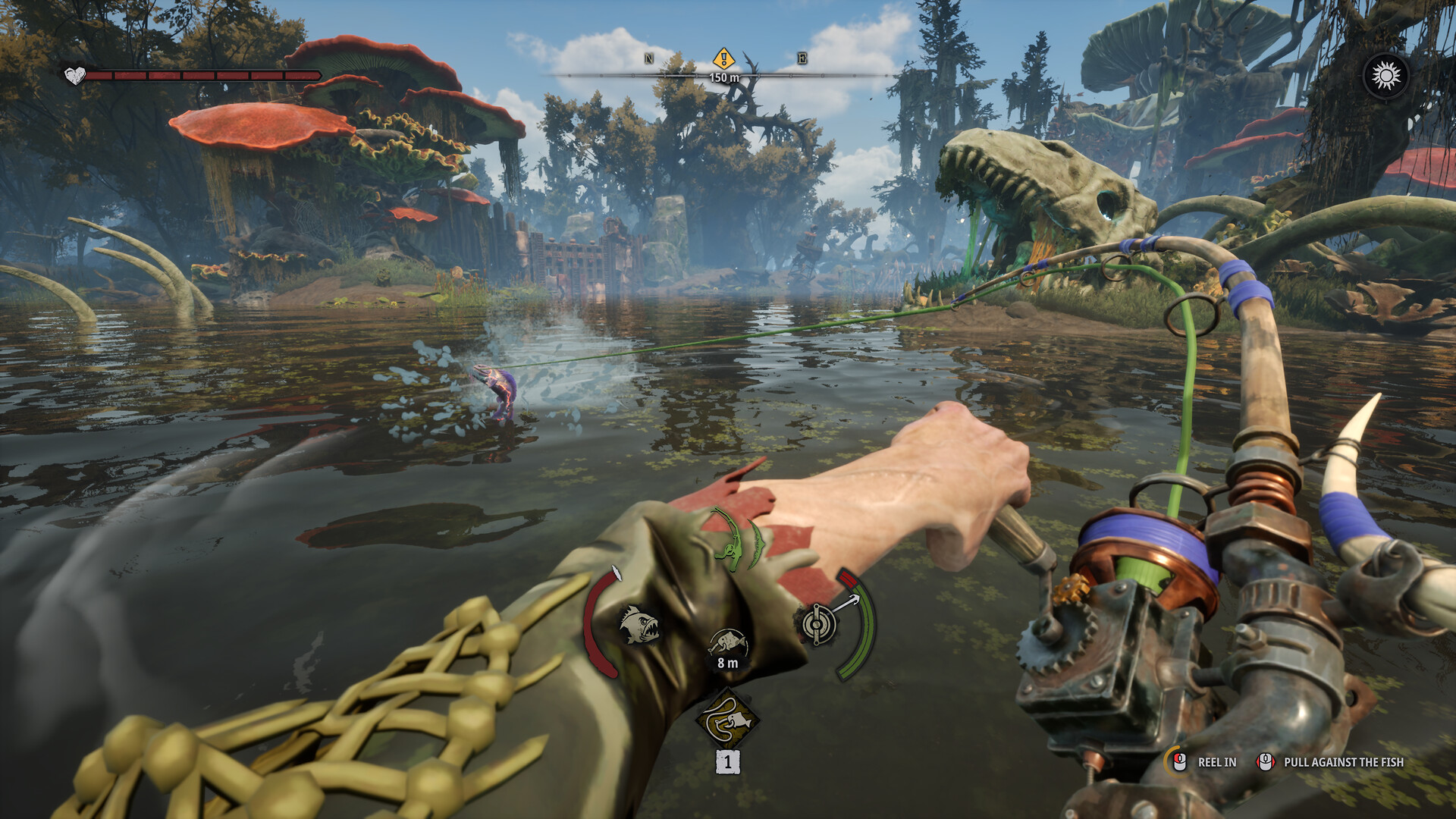
Fishing games are supposed to be relaxing. Dreadmoor missed that memo. Dream Dock's dark first-person fishing adventure launched into Steam Early Access this morning at $19.99, and the pitch fits on a bait box: you fish to stay alive in a drowned world, and the catch bites back. Eight years in the making, one of the 60 most wishlisted games on Steam, and 750,000 wishlists behind it. I spent an unreasonable amount of time watching fishing trailers this week, strictly for research, and this one earned it.
The world: a catastrophe with a fishing rod
The setting is the Submerged Lands, a flooded post-apocalyptic stretch of coastline ruined by a catastrophe that twisted everything in it beyond recognition. Coastal regions sank, settlements cling to whatever stayed dry, and the water hides ruins, shipwrecks, caves, and things that used to be fish. The disaster is called the Sea Blight, and the whole ecosystem is wrong. You are the new arrival trying to make a living in it.
That framing matters. You are not on vacation. You are a working angler in a place where the job description includes getting eaten, and the same water that feeds you is the thing you have to survive.
The loop: fish, sell, upgrade, do not stay out after dark
The core loop is a day on the water, and it is tighter than it looks. You take your rickety trawler out, find the feeding grounds, and set your line. The fish are bloodthirsty, and that is good news for your wallet: the more ravenous and razor-toothed the catch, the better the price back at the shop. Then you head home, sell the haul, refuel, refit the boat, and get a few hours of sleep. Do not stay out after dark, because the things under the waves at night are the ones even skilled anglers refuse to tangle with.
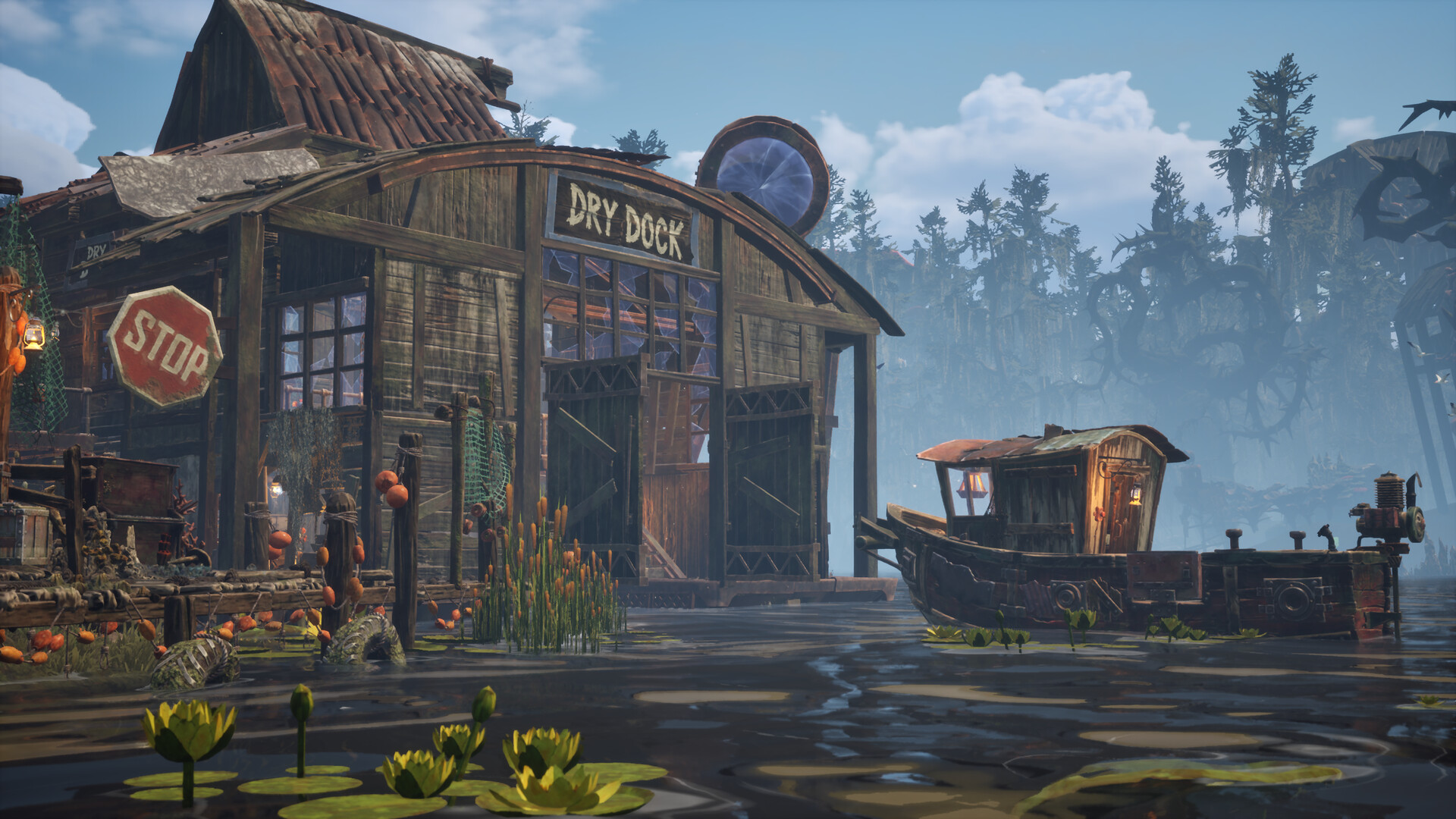
Two details in that loop are doing the heavy lifting. First, the hold is not a safe box: stored creatures eat each other, so a good catch shrinks if you dawdle. Second, the fish are raw material, not just money. You dissect what you catch for organs and body parts, and those become upgraded lures and gear. Salvage from wrecked ships becomes boat components at the dry dock: better armor, a stronger engine, a bigger hold, a searchlight for the dark water, and an afterburner for short bursts of speed when something closes in. The loop feeds itself. Catch stranger fish, build stranger gear, survive stranger water.
The locals are the best part
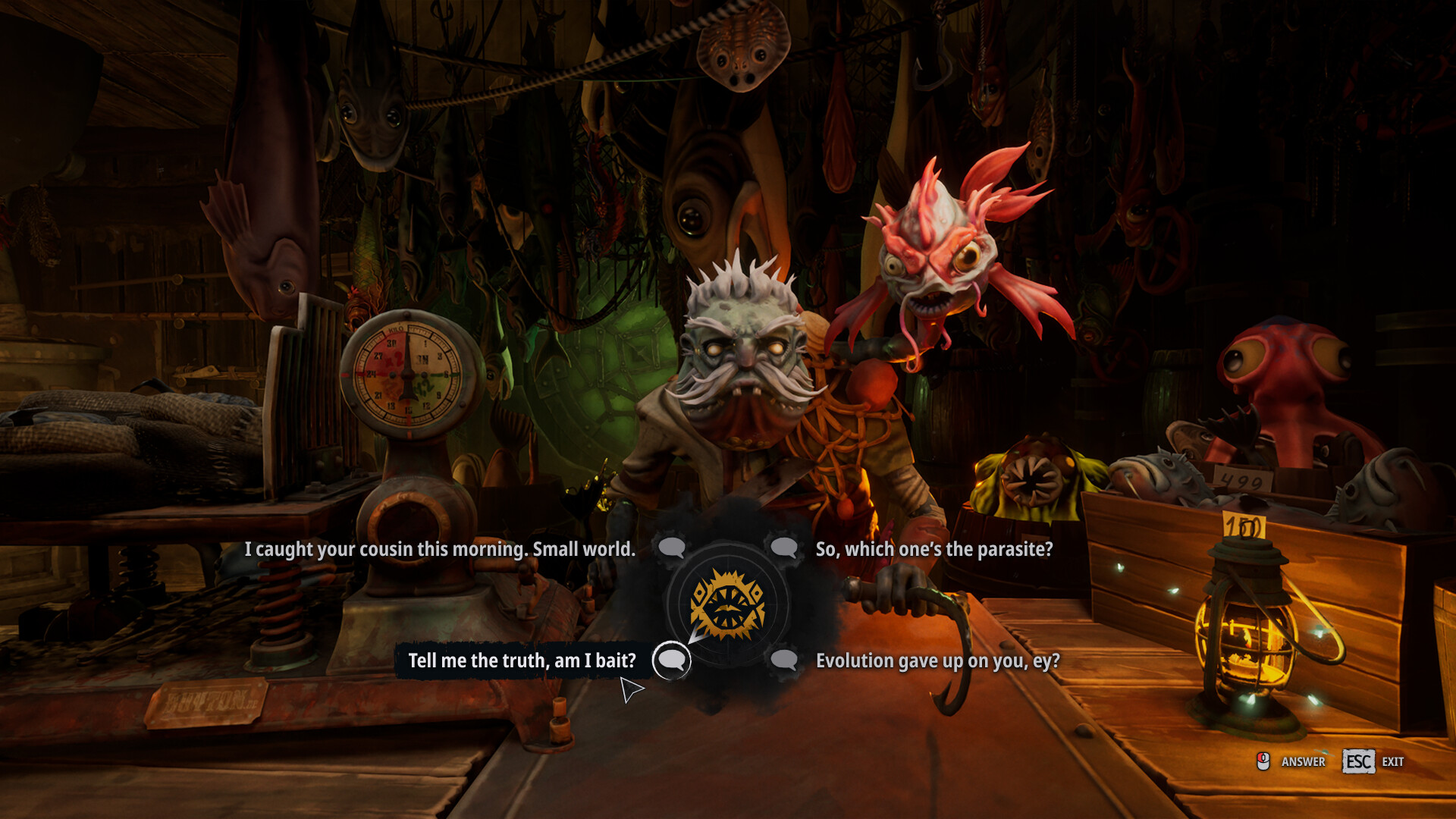
A fishing loop can carry a game for a weekend. Characters carry it for months, and Dreadmoor knows it. The settlements are run by mutant bait shop owners and a half-mad ship's engineer, and the early footage leans into them hard. One official screenshot shows a dialogue scene with a shopkeeper whose idea of small talk is telling you he caught your cousin this morning. The writing has a dry, deadpan edge to it, and the game is happy to let its weirdos be weird instead of sanding them down into quest dispensers.
That is the part of the game I will be watching closest during Early Access. A flooded world is atmosphere. A cast of mutants who remember your last catch is a reason to come back. Dream Dock promises a complete storyline in the Early Access build, not a slice of one, and the story will decide whether this is a great fishing game with horror dressing or a great horror game that happens to involve fishing.
Eight years, three developers, 750,000 wishlists
Dream Dock is a small independent studio based in Kyrgyzstan, founded by three former colleagues who left well-paid roles at larger companies to chase one shared idea. Between them they have six years at studios like Playrix, MY.GAMES, Saber Interactive, and Owlcat Games. Dreadmoor is their debut game, and they have been building it for eight years.
The audience found it fast. Announced in April 2025, the game passed 40,000 wishlists within ten days, and the count kept climbing to more than 750,000 by launch. A free demo landed in October, with its own exclusive questline, and turned wishlists into players who had actually held the rod. Publisher Digital Vortex Entertainment, whose team has worked on Atomic Heart, Lost Ark, and PUBG: Battlegrounds, came aboard to take the game worldwide.
That road matters for the Early Access question, because eight years and 750,000 wishlists create a specific kind of pressure. This is not a scrappy prototype asking players to fund the idea. It is a nearly finished game asking players to help finish it. The difference shows in what shipped today.
Yes, it looks like Dredge. It is not Dredge.
Let us get the comparison out of the way, because everyone will make it, including me, in the same breath. Dredge is the obvious reference: a fishing game in a cursed sea, a day and night cycle, mutated catches, a creeping sense that the water is lying to you. Dreadmoor shares the genre and the mood, and the developers have never pretended otherwise. The inspirations they name are Dredge, Metro Exodus, and Resident Evil.
The differences are structural. Dredge is top-down and turn-based in spirit. Dreadmoor is first-person and real-time: you fight mutated creatures on land and on the water, you explore settlements and wrecks on foot, and the fishing itself is an active struggle with line tension and movement, not a minigame you watch. There is a full story campaign with a defined ending, crafting built from dissected catches, and a boat that grows from a rattling tub into something that can outrun what hunts it. If Dredge is a quiet dread you steer through, Dreadmoor is the same dread grabbing the rod.
What Early Access includes, and the fine print
Here is what is actually in the build that launched today:
- The full core loop: fishing, trading, scavenging, crafting, boat upgrades, and the complete storyline, in one major region.
- After the story ends, you can keep exploring, fishing, and upgrading freely. The game does not stop when the credits roll.
- Early Access lasts six to twelve months, which puts the full release somewhere between May and November 2027. The 1.0 version is planned to add new areas, more fish species, new fishing mechanics, and further boat upgrades.
- The price goes up at 1.0. Today it is $19.99, with a 10 percent launch discount bringing it to $17.99 until November 23. An optional $4.99 Supporter Pack is available for players who want to back the studio further.
- Demo saves do not transfer. The developers confirmed this in October. If you played the demo, you start fresh.
- It is PC only for now, single-player, with text in 12 languages and full voice acting in English and Russian. Minimum specs are modest, a GTX 1060 or RX 580 with 8 GB of RAM, though you will need 60 GB of storage. The demo ran on Steam Deck, but the game has no official Verified rating yet.
That is an unusually complete Early Access launch. The honest risks are the usual ones: the second region does not exist yet, the balance will move as players break the economy, and a six to twelve month window is a promise, not a date.
Buy now or wait for 1.0?
If you like fishing games, horror games, or the specific overlap where a relaxing hobby turns into a survival problem, buy it now. The launch discount, the complete story, and the price rise at 1.0 make the math easy. If you only play finished games and you hate replaying a story after updates change it, wait. The full release will have more regions and more fish, and it will cost more. Both choices are correct: the people who jump in get a real game, and the people who wait get a better one later.
One last thing. The fish eat each other in the hold. I have thought about that sentence all week, and I am still not over it. That is the game in eight words.
Images: Dream Dock / Digital Vortex Entertainment, official Steam screenshots.
Watch the video version: GameNow TV News, Nov 9: Dreadmoor Casts Off Into Early Access Today
More from GameNow TV: GameNow TV on YouTube.