Roblox: 315 Million Visits for a Game Almost Entirely Built by AI, and That Is Only the Start of the Problem
Start with the number that went around the networks, then with the one it must not be confused with. In its third-quarter 2026 shareholder letter, filed October 29 with the US SEC, Roblox states that two games, Break and Steal an Egg and Huss Valley, were built almost entirely with AI and both broke into the platform's top 20 by concurrent players. Break and Steal an Egg, created September 5, showed about 315 million visits as of November 2, with some 103,000 players connected at the time of the count. Huss Valley, created August 31, showed about 232 million on the same date. Together, more than 546 million visits in about nine weeks.
These are real numbers, reported from an official document, and they deserve to be taken seriously. But they do not say what many comments make them say. They do not say that AI has replaced creators, or that these games are good, or that they will last. They say something more precise, and more interesting: on Roblox, the barrier between having a game idea and publishing a playable game has just collapsed, and the entire platform must now manage the consequences.
Two numbers, two different stories
The letter actually contains two claims that must be separated carefully. The first concerns two specific games, built almost entirely with AI. The second is much broader: over the past month, more than 80% of the 100 most played games on Roblox, ranked by hours played, used AI tools to speed up their creation. "Using AI tools" and "being built almost entirely by AI" are not the same thing. The first case includes an established studio that generates assets faster, fixes code faster, or prototypes faster. The second describes a game whose making was largely delegated to models. Mixing the two turns massive adoption of tools into a total takeover by AI, and the letter does not say that.
The letter's other numbers tell the same acceleration story, from several angles. The number of assets uploaded each day to the Roblox cloud tripled month over month. Among the biggest creators, time spent with AI tools tripled since the second quarter, and daily use of Roblox's MCP server, which lets external models plug into Roblox Studio, almost quintupled. Games published using AI rose by more than 50% quarter over quarter. This is not an isolated experiment, it is a change in production pace for the whole platform.
The financial context, meanwhile, tempers the enthusiasm. Roblox reported revenue of 1.572 billion dollars in the third quarter, up 16% year over year, but bookings of 1.697 billion down 12%, daily active users down 9%, and hours played down 15%, after exceptional growth in 2025. In other words, the platform is producing more games than ever, at the exact moment when its audience, measured year over year, is contracting. Producing more is not enough to make people play more.
Build: the sentence that becomes a game
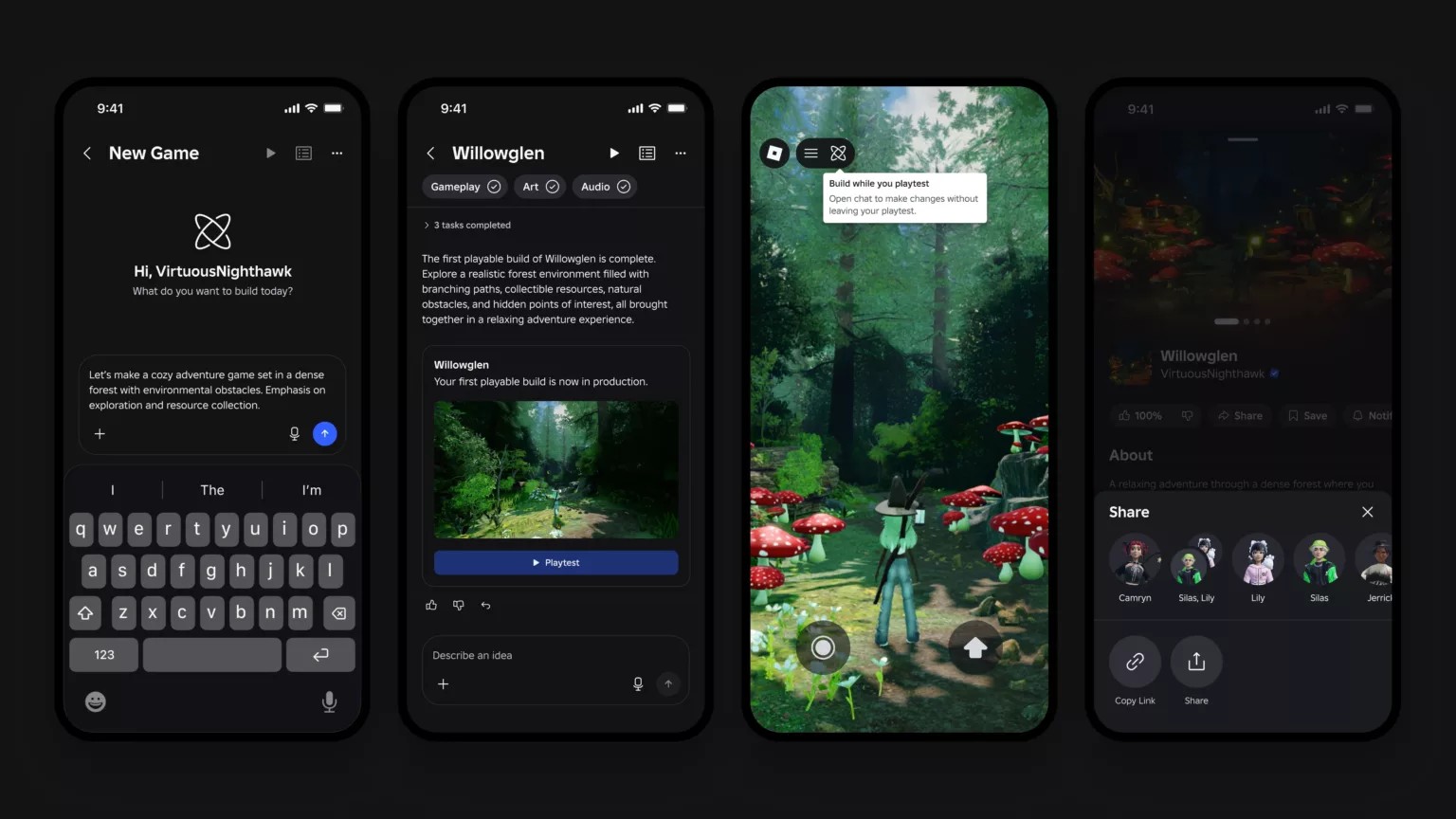
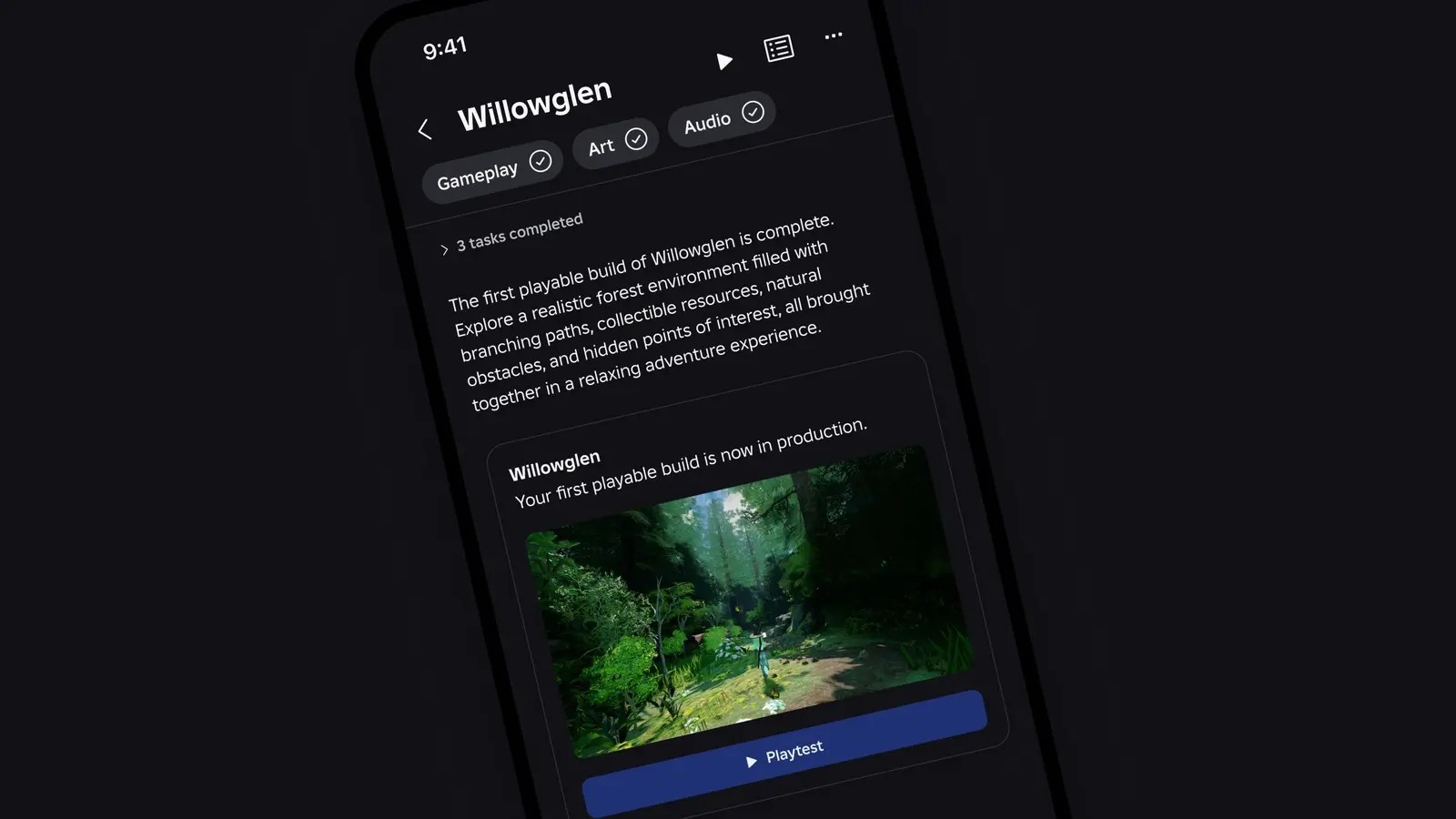
The tool at the center of this acceleration is called Build. Announced in July 2026, it is a mobile tab in the Roblox app that turns a written description into a playable base game, without leaving the app. Type a sentence like "let's create a cozy adventure game in a dense forest", and Build generates a starting point: mechanics, environment, characters, visual style, sounds. The creator can then iterate, test, and publish, or move the project into Roblox Studio to develop it further. The base version is free, with paid options planned for advanced users.
The rollout remains limited, and that is an essential point. Build entered public alpha on July 28 in New Zealand, for verified users aged 9 and up, and then expanded to Singapore, Serbia, and Thailand. Published games are accessible worldwide to verified users aged 16 and up, after the platform's safety checks. Despite this still limited reach, Roblox already reports more than 500,000 Build users and more than 70,000 games published with the tool. For comparison, the company counted only about 100,000 users and 9,000 published games as of October 8. The curve is not linear, it is vertical.
The real bottleneck: discovery, not creation
Here is the point Roblox itself seems to have understood, since it devotes a section of its letter to it titled "Surfacing New Content vs. AI Slop", in essence, bringing new content to the surface against the mass of mediocre AI content. About 40% of the 100 most recommended games each week, measured in impressions, had been created in the previous three months at the end of the third quarter. The platform therefore renews itself very fast, but that renewal is also a problem: when 70,000 games can appear in a few months from a single tool, how does a player find the good ones, and how does a good creator stand out from the noise?
Roblox's current answer rests on retention. Games created with Build pass the same checks, join the same candidate pool, and are ranked by the same retention-based discovery system as other games. In theory, that is reassuring: AI guarantees no visibility, only players who stay count. In practice, it shifts the competition. It is no longer about who can make a game, since almost everyone can now, but about who can bring players back the next day, and the day after. That is a different skill, closer to systems design and community management than to simple content production.
There is also a question of originality that visit counts do not resolve. Break and Steal an Egg describes itself as inspired by an earlier success, an egg-stealing game. It is a tycoon in which you break eggs to hatch rare animals, steal them by passing guards, and install them in a base that earns money. The genre, the format, and the loop are familiar. AI did not invent a new type of game here, it sped up production of a formula that already worked. That is perhaps the most important finding in this whole story: the first wave of games built almost entirely by AI looks a lot like the previous wave, only faster and more numerous.
What the letter does not say
A shareholder letter is an investor document, not an independent audit, and it must be read as such. Roblox does not specify which tools built Break and Steal an Egg and Huss Valley, or how many people worked on them, or for how long. "Almost entirely" is the company's wording, not a measure verifiable from outside. Visit counters, meanwhile, are public and impressive, but a visit is not a loyal player, and a curiosity spike is not a lasting community.
That does not mean these numbers should be dismissed. It means waiting for the second half of the story: will these games still be played in six months? Will their creators know how to evolve them, fix their flaws, add content that justifies a return? A game generated in a few days can attract 315 million visits, but it must then survive the question every game eventually faces: why come back tomorrow rather than try one of the 70,000 other games published the same month?
If you are a creator, the lesson is rather encouraging, provided it is read correctly. The tool does not replace you, it lowers the cost of your first prototype. What will set you apart will no longer be knowing how to make something that works, it will be knowing how to make something worth coming back to. That was already true before AI. It has simply become much more obvious, and much more urgent.
Images: Roblox Corporation, official Build announcement visuals.